
 PacketWatch Team Sixty43
12 min read
Cyber Threat Intelligence Report
This week, for Cybersecurity Awareness Month (Part 2), we briefed our clients on the most common threats their end users will face today.
This week, we briefed our clients on CISA's recently published TTP updates for the Medusa RaaS group, originally published in March 2025.
KEY TAKEAWAYS
New #StopRansomware TTPs for Medusa RaaS. Learn how to protect your organization.
CISA recently published updates to a joint #StopRansomware advisory for the Medusa Ransomware-as-a-Service (RaaS) group. This advisory covers newly observed tactics, techniques, and procedures (TTPs) for the group since the original publication of the advisory in March 2025. Since their debut in June 2021, Medusa has compromised over 500 organizations from a variety of industry verticals including medical, education, legal, insurance, technology, and manufacturing. This article will review these new findings and discuss strategies for protection your organization against them.
Initial Access
Medusa frequently leverages initial access brokers (IABs) to obtain their initial foothold in a victim environment. These IAB affiliates have been observed using the following techniques for initial access:
The updated advisory notes that Medusa tends to operate opportunistically by targeting victims with unpatched software rather than focusing on specific organizations or sectors. There is no indication that they use 0-day or N-day vulnerabilities, and instead use known exploits. To confirm successful exploitation, Medusa uses Interactsh dynamic URLs from oast[.]site, oast[.]pro, or oast[.]fun. This typically has the URL pattern of <victim-name>.<random-33-alphanumeric-characters>.oast[.]site.
Discovery
Medusa uses living-off-the-land (LOTL) techniques and legitimate tools like Advanced IP scanner and SoftPerfect Network scanner for initial enumeration. They typically scan common ports such as 21/FTP, 22/SSH, 23/Telnet, 80/HTTP, 115/SFTP, 443/HTTPS, 1433/SQL, 3050/Firebird, 3128/HTTP proxy, 3306/MySQL, and 3389/RDP. They have also been observed using Windows Management Instrumentation (WMI) for querying system information.
Stealth
This part of the advisory saw several updates, as Medusa has been repeatedly observed using legitimate tools and LOTL techniques to avoid detection.
They use endpoint management tools such as Nezha and MeshAgent for backdoors to compromised endpoints.
Lateral Movement, Credential Access, and Execution
The advisory notes Medusa actors heavily use legitimate remote management software for maintained access, and will often tailor which tool is used based on which tools are already present in the environment. These tools include, AnyDesk, Atera, ConnectWise, eHorus, N-able, BeyondTrust, SimpleHelp, and Splashtop. Remote Desktop Protocol (RDP) and PsExec are also leveraged to move laterally through the network. Medusa will modify firewall rules and modify the registry to allow for RDP connections.
CISA has observed Mimikatz being leveraged for dumping LSASS credentials and to aid in lateral movement.
One of the more unusual methods that was observed is Medusa will use the vssadmin command to create a new shadow copy for the C: drive. They will then copy ntds.dit, system, and security registry hives out of the shadow copy and then delete the shadow copy to prevent discovery. Medusa can use these stolen files to create forged Kerberos tickets.
Medusa was also observed modifying Active Directory Default Domain Policy settings, then setting the Default Domain Policy to "Enabled, Enforced" which overrides stricter Group Policies set by the organization.
Exfiltration and Impact
Medusa uses Bandizip to create archives of files to be exfiltrated. They then use rclone to exfiltrate those files to Medusa C2 servers.
Recently, Medusa has been leveraging PDQ Deploy in Windows environments to deploy the encryptor (typically named gaze.exe") across the network. In Linux environments they instead use SFTP to copy the encryptor across the environment.
How to Protect Your Organization
While this update provides the latest TTPs for Medusa, none of these TTPs use anything particularly fancy or undetectable. Using security best practices will go a long way toward preventing compromise from this group:
Resources
https://www.cisa.gov/sites/default/files/2026-08/aa25-071a-stopransomware-medusa-ransomware-508c.pdf
Vulnerability Roundup
Citrix recently released a security update addressing two new vulnerabilities in NetScaler. The most severe of the flaws is CVE-2026-19490, an authentication bypass vulnerability affecting NetScaler appliances configured as a Gateway or AAA virtual server with SAML Action configured. Specific configuration requirements are listed below:
Additional mitigations can be found in the advisory. Administrators are urged to apply the update as soon as possible:
https://community.citrix.com/techzone-blogs/110_security-updates/security-update-netscaler-adc-and-netscaler-gateway-vulnerabilities-r1602/
https://thehackernews.com/2026/08/critical-netscaler-flaw-can-bypass.html
The August 2026 Security Patch Day for SAP addressed 28 new vulnerabilities, including 4 rated critical. CVE-2026-58231 is a maximum-severity flaw in SAP Commerce Cloud where a default authentication client can be abused for arbitrary code execution. CVE-2026-34265 is a critical vulnerability in SAP NetWeaver Application Server ABAP that allows an unauthenticated attacker to exploit logical errors resulting in memory corruption. A full list of vulnerabilities and associated affected software versions can be found in the SAP advisory here. Administrators are urged to apply the updates as soon as possible.
https://support.sap.com/en/my-support/knowledge-base/security-notes-news/august-2026.html?isu_page=1
CISA recently issued a warning of an active threat targeting critical infrastructure organizations with AI-generated exploit scripts. This campaign is specifically targeting Siemens S7 SeriesProgrammable Logic Controllers (PLCs). The following PLC models have been targeted:
CISA is urging any organization that uses these devices to ensure they are running the latest versions, isolate them from the internet wherever possible, have strong access controls, and employ security tooling to monitor ICS environments for signs of anomalous or malicious activity.
Cisco recently addressed a series of critical vulnerabilities in their Crosswork platforms and Secure Workload Software, including several rated as maximum-severity. The vulnerabilities in the table below affect the following Cisco Crosswork platforms, regardless of device configuration: Crosswork Data Gateway, Crosswork Network Controller, Crosswork Planning, and Crosswork Workflow Manager.
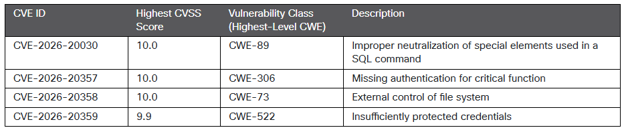
Fig. 1: Cisco Crosswork Vulnerabilities (Source: Cisco)
These vulnerabilities affect Data Gateway, Network Controller, and Planning versions 7.2.1 and earlier, with a fixed release of version 7.2.1-SP. Versions 2.1.1 and below of Workflow Manager are affected, with a fixed release of version 2.1.1-SP.
The vulnerabilities in the table below affect Cisco Secure Workload Software SaaS & on-premises deployments, regardless of device configuration:
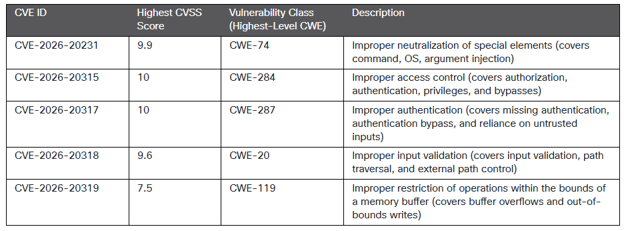
Fig. 2: Cisco Secure Workload Vulnerabilities (Source: Cisco)
These vulnerabilities affect Secure Workload release 3.10 and earlier and version 4.0. Fixed releases are 3.10.9.1 and 4.0.4.16. Administrators are urged to apply the patches as soon as possible.
https://sec.cloudapps.cisco.com/security/center/content/CiscoSecurityAdvisory/cisco-sa-hardening-crosswork-UzDTU9Vh
https://sec.cloudapps.cisco.com/security/center/content/CiscoSecurityAdvisory/cisco-sa-hardening-csw1-shSvndWP
https://thehackernews.com/2026/08/cisco-patches-nine-crosswork-and-secure.html
Cisco recently released details for a new denial-of-service (DoS) vulnerability affecting the Remote Access SSL VPN service for Cisco Secure Firewall Adaptive Security Appliance (ASA) Software and Cisco Secure Firewall Threat Defense (FTD) Software. Per the disclosure, the vulnerability tracked as CVE-2026-20349, can allow for a remote, unauthenticated attacker to send crafted HTTP requests to the device, causing the device to reload, resulting in a DoS condition. To be vulnerable, one of the following conditions must be met on the device:
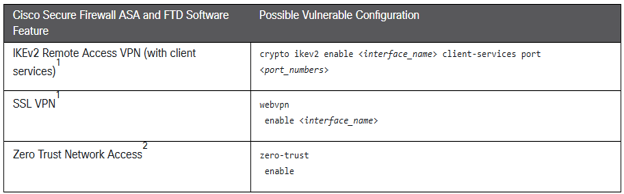
Fig. 3: Cisco ASA & FTD Configurations (Source: Cisco)
The tables below show the ASA and FTD versions with their associated hotfix releases. Administrators are urged to patch as soon as possible.
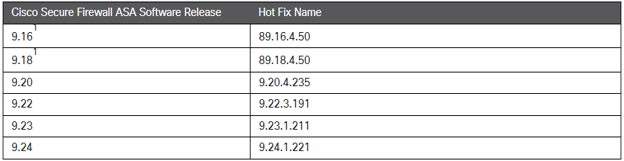
Fig. 4: Cisco ASA Releases and Corresponding Hotfix (Source: Cisco)
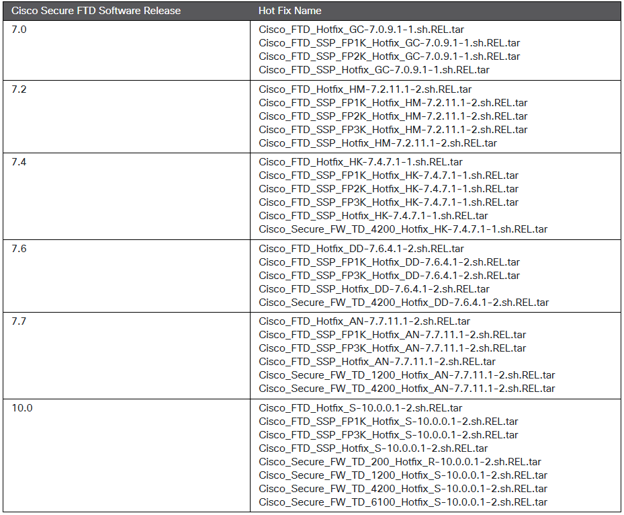
Fig. 5: Cisco FTD Releases and Corresponding Hotfix (Source: Cisco)
https://sec.cloudapps.cisco.com/security/center/content/CiscoSecurityAdvisory/cisco-sa-asaftd-vpn-dos-dzv4mQFF
A code injection flaw that allows an unauthenticated attacker to modify or delete publicly accessible GitLab projects has come under active exploitation according to security firm watchTowr. Tracked as CVE-2026-19478, the flaw affects GitLab Community Edition (CE) and Enterprise Edition (EE) versions 18.2 before 18.11.11, 19.0 before 19.0.8, 19.1 before 19.1.6, and 19.2 before 19.2.4.
GitLab introduced fixed versions 19.2.4, 19.1.6, 19.0.8, and 18.11.11 to address the issue. Administrators are urged to upgrade as soon as possible. Per their research, watchTowr also noted that administrators can check for signs of exploitation by searching web logs for requests containing 'gl_introduced'.
A new security vulnerability in Zimbra Collaboration (ZCS) has come under active exploitation per the Polish Computer Emergency Response Team (CERT Polska). Tracked as CVE-2026-73750, this vulnerability is classified as a command injection flaw that can lead to remote code execution. The application is vulnerable if it is running ZCS before 10.1.20 with the optional zimbra-snmp package installed, and SNMP notifications are enabled. Administrators are urged to patch to version 10.1.20 or greater as soon as possible.
https://blog.zimbra.com/2026/07/patch-release-update-zimbra-10-1-20/
https://thehackernews.com/2026/07/zimbra-patches-critical-snmp-command.html
A high-severity SQL-injection flaw in GeoServer was recently disclosed by security researcher @q1uf3ng. Per the disclosure, if the exploit is ran against the system administrator 'sa' database, remote code execution is achievable. No CVE identifier has been assigned to this vulnerability yet. Versions 3.0.1, 2.28.5, and 2.27.6 have been released to address this vulnerability.
https://geoserver.org/announcements/vulnerability/2026/08/14/geoserver-3-0-1-released.html
https://github.com/geotools/geotools/security/advisories/GHSA-mqjf-5f49-2fjh
https://thehackernews.com/2026/08/unpatched-geoserver-zero-day-targeted.html
The following vulnerabilities were added to CISA's Known Exploited Vulnerabilities Catalog in the last 2 weeks:
This report is provided FREE to the cybersecurity community.
Visit our Cyber Threat Intelligence Blog for additional reports.
Visit our Cyber Threat Profile Blog for detailed intelligence profiles.
Visit our Beyond the Threat Feed Blog for more articles.
Subscribe to be notified of future Reports:
NOTE
We have enhanced our report with data from SOCRadar. You may need to register to view their threat intelligence content.
12 min read
This week, for Cybersecurity Awareness Month (Part 2), we briefed our clients on the most common threats their end users will face today.
11 min read
This week, for Cybersecurity Awareness Month, we briefed our clients on the basics. While it may seem trivial, fundamentals will thwart most...
8 min read
This week, we briefed our clients on a CISA/NSA document, "Detecting and Mitigating Active Directory Compromises." Be sure to implement these AD...