
 PacketWatch Team Sixty43
11 min read
Cyber Threat Intelligence Report
This week, we briefed our clients on an emerging data extortion group, "The Curious Worm," who has targeted healthcare, manufacturing, and legal...
This week, we briefed our clients on an emerging data extortion group, "The Curious Worm," who has targeted healthcare, manufacturing, and legal verticals.
KEY TAKEAWAYS
TTPs on emerging data extortion group: The Curious Worm.
Critical and high severity vulnerabilities Microsoft, ConnectWise, Linux SSH, N-central, SAP, Apache, Citrix, Fortinet, Check Point, Zoom, and PostgreSQL, plus updates to CISA KEV, patch now!
PacketWatch Team Sixty43 has recently encountered an emerging data extortion group who calls themselves "The Curious Worm". The group so far operates with a data-extortion only model; no encryptor was observed. They also appear to be heavily targeting the healthcare industry vertical, with 8 of the 10 victims listed on their leak site from the healthcare industry. The other two victims are from chemical manufacturing and legal verticals. This article will provide a high-level overview of the group's observed TTPs, with more detailed report to be published in the coming days.
Initial Access
The group leverages vishing (voice phishing), posing as IT helpdesk via a Microsoft Teams call. They then convince the user to download and install HopToDesk, a remote management software that gives them access to the victim's machine.
Privilege Escalation
In the cases we observed, Curious Worm works quickly once they have a foothold in their target environment. In one case, they performed DCsync followed by a pass-the-hash attack on the global administrator account in roughly 1 hour after the initial compromise. Using these global administrator credentials, they then compromised multiple other accounts for further access and persistence.
Persistence
One of the more notable tools used by the group is a Deno-based Remote Access Trojan that uses JavaScript, tracked by CrowdStrike as Dindoor. The malicious code was downloaded from 45.61.182[.]162. The JavaScript filename is randomized and is a hash based on the infected host's information and is placed in the %APPDATA%\Roaming\ folder. Once run, it opens a listener on port 10091 and attempts to create a registry object in
HKCU\Software\Microsoft\Windows\CurrentVersion\Run'.
Our investigation also revealed that later on in the intrusion, the group downloaded AnyDesk and GetScreen RMM tools on multiple hosts for even further remote access options. Additional filenames and corresponding hashes observed can be found in the Appendix.
Lateral Movement
The group used a variety of "living off the land" (LOLbins) tools to pivot throughout the environment. We observed usage of RDP, WMI, SMB, and WinRM. Each of these tools were used at different points of the intrusion by the threat actor to pivot between hosts.
Data Exfiltration
The main goal of this group is data exfiltration for extortion purposes. Two tools were observed at this phase of the intrusion. The threat actor used S3Browser, renamed to CSBrowser, to connect to backups and pull data. They then used rclone, renamed to "sync.exe" to push data to servers on BackBlaze. The time window between initial access to data exfiltration was a mere 12 hours.
Conclusion
The Curious Worm is an emerging data extortion group that uses the increasingly popular Fake IT Support vishing technique to gain initial access. They rapidly escalate privileges and establish persistence in the target environment, using known Remote Access tools and LOLBins to pivot and maintain access. Their ultimate goal is to steal sensitive data in bulk and then extort the victims with the threat of publishing the stolen data on their leak site. While none of the TTPs observed in these intrusions are particularly novel, they move with speed and precision to achieve their goals. Additional network IOCs can be found in the Appendix below.
The Curious Worm IOCs - Appendix A
An open-source, large language model-driven agentic "pentesting" framework called ARTEX has seen a rapid rise of abuse from a variety of threat actors in recent months, prompting the FBI to issue a FLASH bulletin on the framework. Per the FLASH bulletin, ARTEX has been leveraged in campaigns targeting organizations around the globe, impacting financial services, government, technology, defense, semiconductor, energy, healthcare, manufacturing, telecommunications, and legal industry verticals.
While the framework does not employ any sort of novel attack, it dramatically reduces the time required to chain attack techniques, with the FBI reporting intrusions progressing from initial targeting to privileged access in less than three hours. Additionally, it allows threat actors with minimal technical expertise to conduct complex attacks, and even attack multiple organizations simultaneously, lowering the technical barrier of attacks and expanding the pool of potential malicious operators.
The FBI strongly recommends organizations take the following steps to harden their environment against these forms of agentic AI attacks:
This list is not exhaustive, and additional recommendations can be found in the FLASH bulletin. Administrators and security operators are strongly encouraged to read the bulletin and implement the best practice and hardening recommendations.
https://www.microsoft.com/en-us/security/blog/2026/11/05/threat-actors-use-agentic-ai-tooling-to-find-and-abuse-exposed-secrets/
https://socradar.io/wp-content/uploads/landing/agentic-ransomware-report-2026.html
https://www.infosecurity-magazine.com/news/artex-activity-exceeds-reported/
https://www.darkreading.com/cyberattacks-data-breaches/artex-ai-pen-test-tool-hackers-weapon
Vulnerability Roundup
Another massive list of 1,259 vulnerabilities were addressed in the November Patch Tuesday for Microsoft. Among these vulnerabilities are over 500 elevation of privilege flaws, and a multitude of remote code execution and information disclosure flaws. Administrators are urged to apply the Patch Tuesday updates as soon as possible. Notable vulnerabilities in this release are detailed below.
https://msrc.microsoft.com/update-guide/releaseNote/2026-Nov
https://thehackernews.com/2026/11/microsoft-patches-1259-flaws-including.html
As part of the November Patch Tuesday updates, Microsoft disclosed CVE-2026-124194, and actively exploited vulnerability in Microsoft Outlook. Successful exploitation requires the attacker to send the victim a specially crafted message file and convince the victim to open the file. This action discloses the user's NTLMv2 hash and sends the has back to the attacker's server over port 445. Administrators are urged to apply the Patch Tuesday updates as soon as possible and ensure outbound traffic to port 445 is blocked at the external firewall.
One notable vulnerability that was addressed by Microsoft in the November Patch Tuesday is CVE-2026-85844, a critical-severity privilege escalation and authentication bypass flaw in Windows Kerberos. While no exploitation in the wild has been observed, the advisory states exploitation of the vulnerability is low complexity and does not require user interaction. Administrators are urged to apply the Patch Tuesday updates as soon as possible.
Last week, ConnectWise published a security advisory detailing a campaign targeting ScreenConnect. Third party research from Huntress revealed the campaign was being used to deploy SCKit, a malicious toolkit used to establish persistent remote access and steal session cookies. An update to the ConnectWise advisory on November 13 urged customers to disable the following third-party extensions until further notice:
However, the Huntress investigation confirms exploitation of specifically the RMM+ extension, due to versions 1.0.31 and 1.0.32 of the extension containing a critical authentication flaw, where a misconfigured extension access key could allow RMM+ to accept a blank one.
The ConnectWise advisory also urges customers to ensure they are running ScreenConnect 26.6.5 or later so that CVE-2026-84869 is patched. This was addressed in the September security update.
Administrators are urged to disable the extensions, apply the security update, and monitor for any anomalous ScreenConnect activity on the network.
A critical authentication bypass vulnerability for OpenSSH server on Alpine Linux was disclosed on November 5th. The flaw, tracked as *sshhole, affects any account whose password field is '*' (an account with no password set, normal for key-only accounts), and where the Linux machine has at least one other account with a '$5$' or '$6$' password hash. If the attacker knows the name of the password-less account, they simply need to send a very long password, 257 to 1024 bytes, and they can then authenticate as that account. Alpine Linux versions 3.21.10, 3.22.8, 3.23.8, and 3.24.4 contain the fixed OpenSSH package. Additional mitigations can be found in the advisory here.
https://alpinelinux.org/posts/2026-11-05-openssh-password-authentication-bypass/
https://ifin.network/t/cve-2026-123158-sshole-ssh-auth-bypass-in-musl-based-linux-distros/965
On November 10, N-able made the rare step of taking N-central Hosted Environments offline and urged customers using on-premises instances to shut down servers until further notice, following the disclosure of 33 0-day vulnerabilities tracked as "Able2Shell." The vulnerabilities allow for a multitude of abuses, including anonymous credential theft, administrator creation, root-level RCE, support token theft, authenticated reverse shells, arbitrary file writes, directory traversal, credential disclosure, and more. Multiple reports of active exploitation in the wild have been reported. N-able has since released N-central 2026.4 HF2 to address some of the vulnerabilities, with additional hotfixes pending. Administrators are urged to apply this hotfix as soon as possible, and monitor the N-able incident page for further information and updates.
https://thehackernews.com/2026/11/n-able-takes-hosted-n-central-offline.html
https://thehackernews.com/2026/11/hackers-exploit-n-central-flaws-to.html
In their November Security Patch Day, SAP addressed a series of critical vulnerabilities across their product lineup, including four vulnerabilities rated at the maximum 10.0 severity score. The table below shows the affected product and versions for the max-severity vulnerabilities:
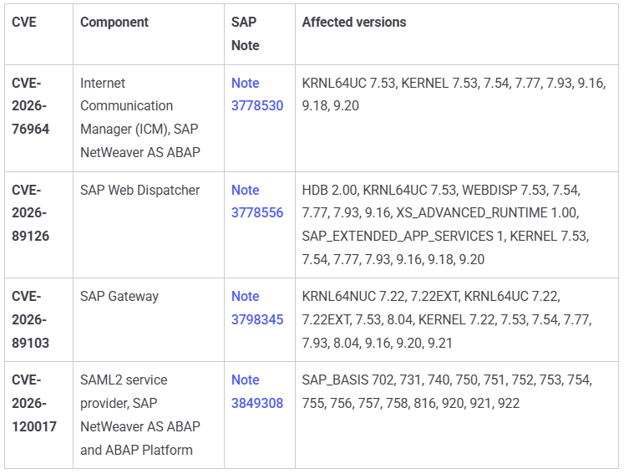
Fig. 1: SAP Maximum-severity vulnerabilities for November 2026 Source: TheHackerNews
Administrators are urged to review the advisory and apply the updates as soon as possible.
https://support.sap.com/en/my-support/knowledge-base/security-notes-news/november-2026.html?isu_page=1
https://thehackernews.com/2026/11/sap-patches-four-cvss-100-flaws.html
A patch was released by Apache for the Apache HTTP Server to address a critical remote code execution vulnerability. Tracked as CVE-2026-119618, the race condition bug in the mod_http2 module allows remote code execution on any server running httpd 2.4.55 through 2.4.70 where HTTP/2 is enabled. Successful exploitation does not require credentials or user interaction. In order to be affected, the server must load mod_http2 and list h2 (HTTP/2 over TLS) or h2c (cleartext HTTP/2) in its Protocols directive, either server-wise or in a single virtual host. So far, no active exploitation has been reported. However, administrators are urged to apply the update as soon as possible.
In a Security Bulletin published on November 12, Citrix fixed over two dozen critical and high-severity vulnerabilities in their NetScaler suite of products. Nine of the vulnerabilities are rated critical, with the descriptions stating that successful exploitation can lead to "unpredictable or erroneous behavior or Denial of Service." Per the advisory, the following devices and versions are affected:
Administrators are urged to review the bulletin and apply the appropriate updates as soon as possible.
https://support.citrix.com/support-home/kbsearch/article?articleNumber=CTX697305
https://thehackernews.com/2026/11/citrix-patches-12-netscaler-and-secure.html
On November 10, Fortinet published a security advisory addressing a critical remote code execution vulnerability in FortiSASE-Sovereign, FortiAnalyzer, FortiManager, FortiAnalyzer Cloud, FortiManager Cloud, and FortiAnalyzer Big-Data GUI. Tracked as CVE-2026-126170, the vulnerability allows an unauthenticated attacker to execute unauthorized code or commands via a specially crafted HTTP request. A full list of affected and fixed versions can be found in the advisory, as well as a configuration for a potential workaround. Administrators are urged to apply the update as soon as possible.
Check Point recently reported active exploitation of a local privilege escalation flaw that affects Check Point Force Firewalls, Check Point Management and Log Servers, Multi-Domain Security Management and Multi-Domain Log Server, and Maestro Orchestrator devices. Tracked as CVE-2026-123039, the flaw allows any authenticated local user to run arbitrary commands as root. Affected versions are R82.20, R82.10, R82, R81.20, R81.10, and R81. Administrators are urged to apply the hotfix as soon as possible. Additional mitigations and commands for searching for indicators of compromise can also be found in the support page.
The latest software update for Zoom fixes 2 privilege escalation vulnerabilities in Zoom Workplace for Windows, including one that is rated critical severity. The flaw, tracked as CVE-2026-108186, is an "improper input validation vulnerability that could allow an unauthenticated user to conduct and escalation of privilege via network access." This vulnerability affects Zoom Workplace for Windows starting at version 7.1.0 and before version 7.1.8. The second vulnerability, tracked as CVE-2026-108187, affects Zoom Workplace for Windows before version 7.15. Administrators are urged to apply the updates as soon as possible.
PostgreSQL released sweeping updates addressing 52 new vulnerabilities in the database platform. The most notable vulnerability in this set is CVE-2026-6460, which allows a database user with "object creator" permissions to execute arbitrary code on the underlying operating system. In addition to applying the latest versions (18.7, 17.12, 16.16, 15.20, and 14.25), full protection against this particular vulnerability requires "rebuilding C-language extensions." Administrators are urged to apply the updates and thoroughly review the release not documentation for further mitigations.
The following vulnerabilities were added to CISA's Known Exploited Vulnerabilities Catalog in the last 2 weeks:
Network IOCs:
45.61.182[.]162 - Payload C2
149.137.140[.]232 - Backblaze
51.158.148[.]82 - HideMyIP VPN
45.76.236[.]44 - turn.hoptodesk[.]com
208.87.243[.]197 - HideMyIP VPN
23.95.73[.]236 - HideMyIP VPN
167.150.100[.]36 - turn-sg.hoptodesk[.]com
167.233.23[.]63 - signal.hoptodesk[.]com
185.126.237[.]11 - HideMyIP VPN
78.47.224[.]17 - turn-eu.hoptodesk[.]com
104.153.238[.]47 - Backblaze
hhevzhgcokx6xlzh4o4exuo2kryy6ectpb7trm5ut2g3u4trskptv7ad[.]onion - Data Leak Site
File IOCs:
vpn_update_0xc2.msi
MD5: 735424b73bc0b5ad1583839111aaca60
SHA-1: c7fb7abcd87640ebd3457f11041be781d8af6b64
SHA-256: 0749da962da7976b8dd3a546e383f4ac982dd865359942fa63854d6bd21759ce
November95.cmd
MD5: 609023e60d3813ce57e5d50edf75a49a
SHA-1: 00258f89e573e3b36e7af870e6c9302abb84d34f
SHA-256: 2801508ad8c23061075ff7af38e631ec2e36c241daa220f2fc66fbbb175b6816
whiskey29.ps1
MD5: 3dca793e03f772d5590bc56860b4fe73
SHA-1: f20b01c0e0a2128f0be340b205d3e49621b6ca58
SHA-256: ab03d2966db57af78b900ec394cf8ea7d01b07bcd91fdc5ed005a9508a74fbdb
hotel_utility42.dat
MD5: 3fee0aad53f6970df052a3c306da7fa7
SHA-1: 66e076d53b2b2697902686162d3b6a5e1a794c81
SHA-256: e3ffbe69c618483a948b3e00d360d9300a50e425cfdb4f13b75797e6456b07fc
This report is provided FREE to the cybersecurity community.
Visit our Cyber Threat Intelligence Blog for additional reports.
Visit our Cyber Threat Profile Blog for detailed intelligence profiles.
Visit our Beyond the Threat Feed Blog for more articles.
Subscribe to be notified of future Reports:
NOTE
We have enhanced our report with data from SOCRadar. You may need to register to view their threat intelligence content.
11 min read
This week, we briefed our clients on an emerging data extortion group, "The Curious Worm," who has targeted healthcare, manufacturing, and legal...
12 min read
This week, we briefed our clients on shifting their mindset. Act as if you're already compromised and focus on controls to limit a full domain...
12 min read
This week, for Cybersecurity Awareness Month (Part 2), we briefed our clients on the most common threats their end users will face today.